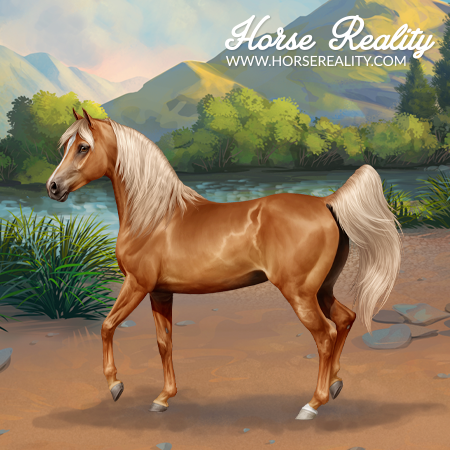
The Arabian Horse is a breed available in the Horse Reality game that can be obtained from the Foundation.
| Arabian Horse | |
|---|---|
|
|
| General Information | |
| Alternative names | Arabian, Arab Horse |
| Origin | Arabian Peninsula |
| Horse Reality | |
| Colours | Black, Chestnut, Bay, Wild Bay, Seal Brown, Flaxen, Sooty, Grey |
| Whites | White Markings, Rabicano, Hidden Sabino, W3, W19 |
| Not yet in-game | W15, W20, W23, Non-Dun1 |
| Height | 140 - 167 cm |
| Registry | Arabian Horse Society |
| Alternative names | Arabian, Arab Horse, Arab |
| Origin | Foundation |
| Status | In-game (2018) |
| Artists | |
| Lineart | D. Grochowska (2022) |
| Greyscale | D. Grochowska (2022) |
| Colours & patterns | D. Grochowska, H. Hegele (2022) |
¶ History
The Arabian Horse is one of the oldest horse breeds in the world. They originated on the Arabian Peninsula. Although the exact place of origin is debated, the most common belief is that the breed originated in the Fertile Crescent. They were bred by the nomadic Bedouin tribes, who used them as war mounts and as a close family companion. The horses were considered a gift from Allah and were highly regarded. The harsh desert conditions and this close affinity to people created a horse that was loyal, spirited, and intelligent, with great endurance.[1,2]
¶ Characteristics
Often called a symbol of elegance and beauty, the Arabian Horse is among the easiest to recognise breeds. One of the most characteristic traits of the Arabian is a delicate head with large eyes set on an elegant, arched neck. Its dry or well-defined legs carry a body with sloping shoulders, a deep, wide chest and a short back followed by a flat croup. The tail should be naturally carried high, completing an image of grace. Arabians are not very tall, as some of the smallest representatives are rather pony-sized, but the breed is classified as a horse nonetheless.[1]
¶ Colour Genetics
The Arabian Horse can have any base coat colour: black, chestnut, wild bay, bay and seal brown, which are often enhanced by flaxen and sooty. The breed is also known for its grey colour, often including a trait called a bloody shoulder, which is an area of concentrated pigment on the body.
The Arabian has unique white spotting alleles, W3 and W19, that create nearly white and “sabino-like” phenotypes. Additionally, there are also untestable patterns present: rabicano and a pattern commonly referred to as “hidden sabino”.
¶ In-game alleles
All alleles available for the breed can be found below, highlighted in green. For better clarity, we bolded alleles that impact coat colours (eg. grey G vs non-grey g).
| Base Colours & Modifiers | ||
|---|---|---|
| Extension | Agouti | Grey |
| E, e | A+, A, At, a | G, g |
| Dilutions | ||||
|---|---|---|---|---|
| Cream-Pearl | Dun | Champagne | Silver | Mushroom |
| n | nd2 | ch | z | n |
| White Patterns | |||||
|---|---|---|---|---|---|
| Frame | Appaloosa | PATN1 | MITF | SW2 | KIT |
| n | lp | patn1 | n | sw2 | W3, W19, n |
Please note that the table includes hidden agouti alleles (A+, and At). Besides testable genes, untestable ones are also present: sooty, flaxen, rabicano, hidden sabino, and white markings (head markings, socks, etc.).
¶ Uses
The breed excels at endurance competitions under tough conditions. It also performs well in other equestrian sports and is loved in shows due to its flashy appearance. For these and many more reasons, the Arabian Horse has been used to improve many other horse breeds.[1]
¶ Artwork Changelog

Artwork Updates
The Arabian is one of Horse Reality's oldest breeds, dating back to the alpha version around 2013. Ever since the current Horse Reality version has been online, the Arabian received/will receive the following updates:
- On October 14th 2020, new coat variations (colour) were added[3]
- On October 19th 2022, the Arabian Horse received new artwork[4]
- On April 28th 2026, the Arabian horse was transferred to the new art system[5][6]
- On May 13th 2026, some artwork fixes were implemented[7]
- The missing genes and alleles will be added to the game through the Foundation[8][9]
¶ Artwork Legacy
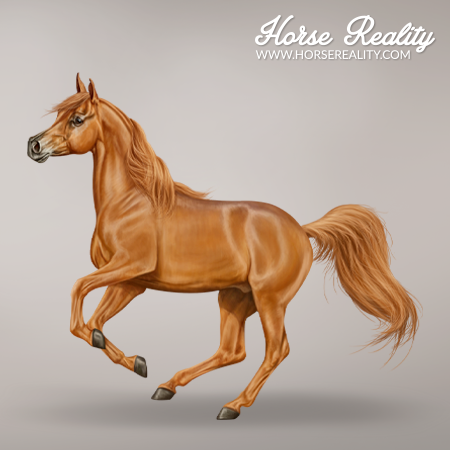
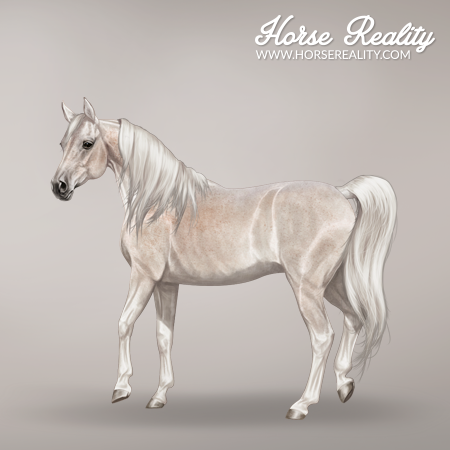
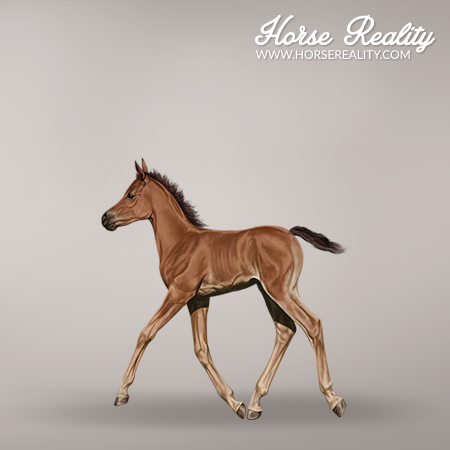
If you're curious about what the Arabian Horse looked like before the artwork update or just want to reminisce good old times - search no more.
|
|
|
This beautiful art was created by very talented artists. Horse Reality is forever grateful for them being a part of its history.
| Artists | |
|---|---|
| Lineart | M. Simon (2013) |
| Greyscale | M. Simon (2013) |
| Colours & patterns | T. van den Berg (2013), Fabueen (2019), H. Vasseur (2019-2020) |
¶ References
- T. Pickeral, The Majesty of the Horse: An Illustrated History, HarperCollins Publishers Limited, 2012
- https://www.arabianhorses.org/discover/arabian-horses/; Access: October 2025
- https://v2.horsereality.com/news/34/birthday-surprise-new-horse-colour-variations-small-community-update-v2-transfer-bugfixes
- https://v2.horsereality.com/news/115/community-update-arabian-horse-redo-foal-calendar-scheduled-downtime-for-server-move-discord-birthday-contest-winners
- https://v2.horsereality.com/news/282/coming-soon-the-5th-migration-batch-arrives-april-28
- https://v2.horsereality.com/news/284/release-notes-arabian-horses-knabstruppers-migrated
- https://v2.horsereality.com/news/291/hotfix-arabian-horse-knabstrupper-migration
- https://deloryan.notion.site/Horse-Breeds-Artwork-Genetics-6d0a84be35284b12806976bbb8cc886c
- https://v2.horsereality.com/news/25/brumby-arrival-on-july-28th-rules-update-thoroughbred-community-poll-foundation-names-changed