The Quarter Horse is a breed available in the Horse Reality game that can be obtained from the Foundation.
| Quarter Horse | |
|---|---|

|
|
| General Information | |
| Alternative name | American Quarter Horse (AQHA) |
| Origin | United States |
| Horse Reality | |
| Colours | Black, Chestnut, Bay, Wild Bay, Seal Brown, Flaxen, Grey, Cream, Pearl, Dun, Champagne, Silver |
| Whites | White Markings, Frame, SW1, Roan, W10, Rabicano |
| Not yet in-game | SW2, W20, Appaloosa, PATN1, PATN2, Non-Dun1, Sooty, SW3 |
| Height | 142 - 170 cm (14-16.4 hands) |
| Registry | Quarter Horse Society |
| Alternative names | Quarter, QH |
| Origin | Foundation |
| Status | In-game (2018) |
| Artists | |
| Lineart | D. Grochowska (2023) |
| Greyscale | D. Grochowska (2023) |
| Colours & patterns | D. Grochowska, H. Vasseur (2023, 2026) |
¶ History
The Quarter Horse, or American Quarter Horse, is one of the most popular breeds from North America. The breed was named after its exceptional ability to sprint short distances and excel in races of a quarter mile (400 metres).
The origin of the breed traces back to the early 1600s, when English settlers in Virginia and the Carolinas began crossbreeding imported early Thoroughbreds with Chickasaw horses to create versatile working and riding horses. Chickasaw Horses were compact and agile horses bred by the Chickasaw tribe, developed from Spanish Barbs who were brought to America by earlier Spanish explorers. These crosses became known as "Celebrated Quarter Running Horses". Racing was very popular among settlers, but since long, oval courses weren't available, people used what they had: short, straight roads, often through villages, typically a quarter-mile distance. The Quarter horses consistently beat the long-distance-running Thoroughbreds and, unlike them, they weren't just racers, but they also ploughed fields, pulled wagons and carried travellers.[1,2]
In 1752, the Thoroughbred stallion Janus was imported. He was a grandson of Goldophina Arabian, one of the three foundation sires of the Thoroughbred and had a big influence on the Quarter Horse, passing on his compactness, strength, and power. As the settlers pushed westward towards Texas in the 1800s, the Quarter Horses moved with them. Another stallion, Sir Archy, strongly influenced the Quarter Horse during this time. Among his descendants were famous stallions like Shiloh and Copper Bottom, as well as Steel Dust. His influence was so great that Quarter Horses were often called “Steeldusts”.[1-3]
Following the American Civil War (1861–1865), the Quarter Horse gained a new identity as a cow horse. As a large number of Longhorn cattle roamed the land and the demand for beef increased in the aftermath, Texas shifted to open range cattle farming. People needed agile horses that could accelerate quickly and turn sharply when handling fast-moving and sometimes aggressive cattle. Quarter Horses were bred with Mustang mares, creating an agile, hardy horse with a unique “cow sense”, a natural ability to respond to cattle.[1,2]
Although Quarter Horses had been bred and recognised as a distinct type for a long time, a formal registry was only established in 1939: the American Quarter Horse Association, with efforts from people like William Anson and Robert Denhardt to define the breed and research its history. As the Quarter Horse became more established, selective breeding led to the development of different types within the breed, each focused on specific disciplines such as halter, cutting, or racing horses.[1-3]
¶ Characteristics
The Quarter Horse is a compact, muscular breed. They typically have a short, broad head with small ears and a well-proportioned neck with sloping shoulders. Their chest is deep and broad, and their hindquarters are rounded and very muscular. The exact conformation and height vary between breeding lines; halter horses tend to have very heavy muscling and are often taller, while reining or cutting horses are typically a bit smaller and are bred to be quick and agile.[3,4]
The breed is typically calm, intelligent and reliable. They are quick to learn and easy to train, which makes them very versatile and a popular choice for both experienced or competitive riders and beginners.[4]
¶ Colour Genetics
The Quarter Horse can have a wide variety of coat colours. Chestnut, often called sorrel in the breed, is common, along with the other base colours. The cream and dun dilutions are fairly common. Champagne and pearl are quite rare, and silver is known only in very few families. Grey also occurs in the breed.[4]
Although many white patterns are present in the breed, excessive white is often considered undesirable, and for a long time horses with too much white could not be registered. Nowadays, Quarter Horses with white patterns can be registered if both parents are AQHA registered and their parentage is confirmed via DNA testing. White patterns in the breed include several splashed white variations, frame overo, roan, white spotting, and rabicano, as well as regular white markings.[4]
¶ Alleles
All alleles available for the breed can be found below, highlighted in green. For better clarity, we bolded alleles that impact coat colours (eg. grey G vs non-grey g).
| Base Colours & Modifiers | ||
|---|---|---|
| Extension | Agouti | Grey |
| E, e | A+, A, At, a | G, g |
| Dilutions | ||||
|---|---|---|---|---|
| Cream-Pearl | Dun | Champagne | Silver | Mushroom |
| CR, prl, n | D, nd2 | CH, ch | Z, z | n |
| White Patterns | |||||
|---|---|---|---|---|---|
| Frame | Appaloosa | PATN1 | MITF | SW2 | KIT |
| OLW, n | lp | patn1 | SW1, n | sw2 | RN, W10, n |
.
Please note that the table includes hidden agouti alleles (A+, and At).. Besides testable genes, untestable ones are also present: flaxen, rabicano, and white markings (head markings, socks, etc.).
¶ Uses
Quarter Horses are popular in many western disciplines including reining, barrel racing, and cutting, but they can also be used for English disciplines and recreational riding.
¶ Artwork Changelog
The Quarter Horse was added to the game in 2018. Ever since the current Horse Reality version has been online, the breed has received/will receive the following updates:
- On 15th February 2023, the breed received new artwork[5]
- On October 13th 2026, the Quarter Horse was migrated to the new art system, and grey was added to the breed[6,7]
- The missing genes and alleles will be added to the game through new Foundation horses.[8,9]
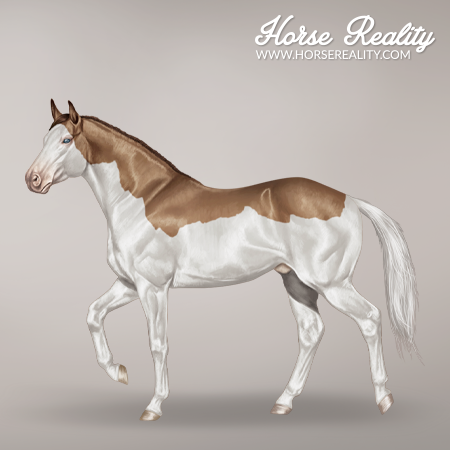
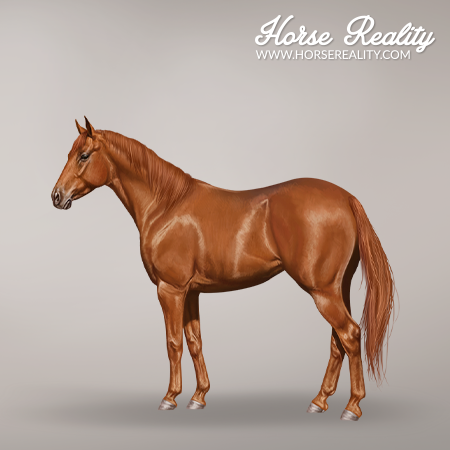
¶ Artwork Legacy
If you're curious about what the Quarter Horse looked like before the artwork update or just want to reminisce about good, old times - search no more.
|
|

|
This beautiful art was created by very talented artists. Horse Reality is forever grateful for them being a part of its history.
| Artists | |
|---|---|
| Lineart | M. Simon (2014) |
| Greyscale | M. Simon (2014-2016) |
| Colours & patterns | T. van den Berg (2016), Jessy (2018), H. Vasseur |
¶ References
- AQHA, The History of the American Quarter Horse Breed: https://www.aqha.com/web/aqha/history-of-the-quarter-horse; Access: September 2026
- Texas State History Association, The Evolution of the American Quarter Horse: From Sprinter to Versatile Ranch Companion: https://www.tshaonline.org/handbook/entries/quarter-horses Access: September 2026
- Petersen JL et. al.; The American Quarter Horse: Population Structure and Relationship to the Thoroughbred; Journal of Heredity, 2013
- American Quarter Horse Association, Official Handbook of Rules and Regulations, 74th edition, 2026
- https://v2.horsereality.com/news/127/community-update-massive-sales-quarter-horses-redo-art-survey-results-art-plans
- https://v2.horsereality.com/news/305/8th-anniversary-upcoming-quarter-horse-migration-on-oct-13-qa-daily-gifts-more
- https://v2.horsereality.com/news/310/8th-anniversary-quarter-horse-migration
- https://deloryan.notion.site/Horse-Breeds-Artwork-Genetics-6d0a84be35284b12806976bbb8cc886c
- https://v2.horsereality.com/news/52/community-update-v2-market-postponed-preparing-3rd-foundation-generation-about-breed-redos-new-art-intern-march-background