¶ Appaloosa Horse |
|
|---|---|
|
|
| General Information | |
| Alternative name(s) | / |
| Origin | United States |
| Horse Reality | |
| Colours | Black, Chestnut, Bay, Wild Bay, Seal Brown, Sooty, Flaxen, Grey, Cream, Dun, Non-Dun1 |
| Whites | Appaloosa, PATN1, PATN2, SW1, white markings |
| Not yet in-game | SW4 |
| Height | 142 - 163 cm |
| Registry | Horse Society |
| Alternative name(s) | Appy, Appies |
| Origin | Foundation |
| Status | In-game (2026) |
| Artist(s) | |
| Lineart | D. Grochowska (2026) |
| Greyscale | D. Grochowska (2026) |
| Colours & patterns | D. Grochowska, M. Krale (2026) |
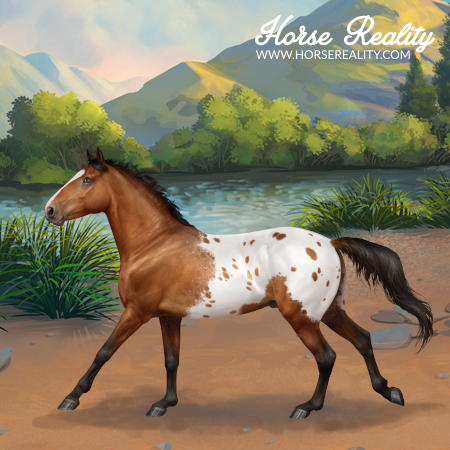
The Appaloosa is a breed available in the Horse Reality game that can be obtained from the Foundation.
¶ History
The ancestors of the Appaloosa were likely first imported to the Americas by the conquistadors in the 1600s. Especially during the 1700s, many spotted horses were imported as they went out of style in Europe. In the early 1700's, these horses were discovered by the Nez Perce Tribe, who lived in the Northwest of the USA, modern-day Idaho, Washington, and Oregon. They developed a strict breeding program that included gelding or trading horses they believed inferior. They selected for intelligence, speed, stamina and endurance, producing a versatile hunting and war horse. At the same time, close contact with the tribe demanded a calm and sensible temperament. As a result, the Nez Perce horses were highly regarded by both Native Americans and European settlers. Early settlers referred to these horses as “Palouse horses,” named after the Palouse River that flowed through Nez Perce territory. Over time, this name evolved into “Appaloosa”.[1-3]
The Appaloosa suffered greatly following the Nez Perce War in 1877. There was increasing tension and pressure from the US to give up their land and move into reservations; however, many Nez Perce refused. Several warriors launched an attack on the settlers, which officially started the war. The Nez Perce leader Chief Joseph then led a retreat all the way to Canada. During their journey, they travelled over 1800 km (1,100 miles) and successfully held off US troops that were many times larger with the help of their agile horses, but were forced to surrender in northern Montana, just before the Canadian border. Most horses were confiscated and either killed, sold or escaped. The Nez Perce were banished to reservation lands, where they had to breed their remaining horses to draft horses in an attempt to create better farm horses. The Appaloosa was nearly lost forever.[1-3]
Thankfully, a small group of passionate horse people set out to save and restore the Appaloosa to its former quality. The Appaloosa Club, the breed registry for the Appaloosa, was formed in 1938. To help revive the breed, they were crossed with other breeds, including the Arabian Horse, Thoroughbred and Quarter Horses. As a result, many modern Appaloosas differ quite a bit from the old-type Appaloosas; however, some breeders focus on “foundation-bred” Appaloosas: descended from the original Appaloosa stock, with little to no outcrossing.[1-3]
¶ Characteristics
In general, the Appaloosa is a very versatile, agile breed with great endurance. Their average height is 142 - 163 cm (14-16 hands). The breed is very hardy with strong bones and hooves. The Appaloosa is intelligent, hardworking and loyal. The mane and tail are often sparse, although this trait appears to be mostly linked to their spotted coat patterns. The old-type or “Foundation” Appaloosa is tall and slender with long, thin limbs and sometimes a slightly convex head profile, while “modern” Appaloosas usually have a more stocky and often even Quarter-Horse-like build.[1-3]
Some Appaloosas have an extra gait called the “Indian shuffle” (not yet in-game!). This gait is very smooth and can be classified as a broken pace. What sets the shuffle apart is that the hind legs literally shuffle as they set down under the horse.[4]
¶ Colour genetics
The Appaloosa is most well-known for its spotted coat patterns, although solid coloured horses are also possible. They can have any base colour, as well as cream, dun and non-dun1. Grey is rare; breeders often avoid it because it hides the spots. White markings are possible, but generally not loud/ common. Splashed white patterns also appear in the breed.
¶ Alleles
All alleles available for the breed can be found below, highlighted in green. For better clarity, we bolded alleles that impact coat colour (eg. grey G vs non-grey g).
| Base Colours & Modifiers | ||
|---|---|---|
| Extension | Agouti | Grey |
| E, e | A, a | G, g |
| Dilutions | |||
|---|---|---|---|
| Cream-Pearl | Dun | Champagne | Silver |
| CR, n | D, nd1, nd2 | ch | z |
| White Patterns | |||||
|---|---|---|---|---|---|
| Frame | Appaloosa | PATN1 | MITF | SW2 | KIT |
| n | LP, lp | PATN1, patn1 | SW1, n | sw2 | W20, n |
Please note that the table includes hidden agouti alleles (A+, and At). Besides testable genes, untestable ones are also present: sooty, flaxen, PATN2, and white markings (head markings, socks, etc.).
¶ Uses
The Appaloosa Horse is versatile and a popular choice for many different disciplines. They are often used in Western disciplines like reining, barrel racing, pole bending, etc., but can also be seen in English disciplines like show jumping, eventing and endurance.
¶ Artwork Updates
The Appaloosa was released in 2026.[5,6] Ever since the current Horse Reality version has been online, the breed has received/will receive the following updates:
- On June 30th 2026, the Appaloosa was added to the game[5.6]
- The missing genes and alleles will be added to the game through new Foundation horses[7]
¶ References
- Appaloosa Horse Club, https://www.appaloosa.com/
- Appaloosa Horse Club UK, https://aphcuk.org/
- Australian Appaloosa Association, https://appaloosa.org.au/history/
- Vincelette, A, The Characteristics, Distribution, Function, and Origin of Alternative Lateral Horse Gaits, 2023
- https://v2.horsereality.com/news/295/coming-soon-appaloosas-arrive-june-30-daily-login-gifts
- https://v2.horsereality.com/news/294/release-notes-appaloosas-are-here
- https://deloryan.notion.site/Horse-Breeds-Artwork-Genetics-6d0a84be35284b12806976bbb8cc886c