Each horse in Horse Reality consists of around 50 genes. Together, they determine how the horse looks, moves, how healthy and fertile it is, and where its talents may lie. You can find all the information about the genes of your horse in the various tabs of its profile.
The genes in Horse Reality are separated into five groups, commonly called "stats": colour genetics, genetic potential, conformation, health and height.
¶ Inheritance of Alleles
On Horse Reality, nearly all traits, from coat colour to conformation, are inherited through genes. Most genes come in pairs, meaning every horse has two copies of the gene. Genes often have different possible variants. These variations are called alleles. When breeding two horses, the foal inherits one allele at random from each parent.
Each horse inherits:
- One allele from the dam
- One allele from the sire
Which allele is passed on is random (50/50 for each allele). For example, if a parent has:
- A / B
It can pass either A or B to the foal.
Depending on which alleles are passed on, the foal could have better or worse traits than its parents, and, for example, it's possible to breed two black jumping horses and still have a foal that is neither black nor good at jumping. It also means that if you breed the same parents again, the next foal might be totally different. The more you learn about genetics, the better you will know what to expect when you breed two horses.
A Punnett square is a simple way to visualise the possible allele combinations a foal can inherit. For a single gene, draw a 2x2 grid. Write the alleles of one parent (e.g., A and B) down the left side and the other parent's alleles (e.g., C and D) along the top. Then fill in the middle boxes by combining the parents' alleles of the corresponding row and column. The boxes then show possible genetic combinations for the foal, each with a 25% chance of happening.
| Dam | |||
| Sire | C | D | |
| A | A/C | A/D | |
| B | B/C | B/D | |
Note: Height is the only gene in Horse Reality that is not inherited via two alleles!
With the basics of allele inheritance covered, let's look into how this applies to the different stat/ traits on Horse Reality.
¶ Colour Genetics
Colour genes in Horse Reality follow the same genetic principles as in real life. Their alleles can be:
- Dominant: Needs only one copy to be expressed (e.g. A/a = A/A)
- Recessive: Needs two copies to be expressed (e.g. a/a); if only one copy is present (e.g. A/a) the allele is carried but hidden.
- Incomplete dominant: One allele is not fully dominant over the other, leading to an intermediate expression when one copy is present (e.g. the cream allele)
Dominant alleles are represented by a capital letter and recessive alleles by a lowercase letter. When a horse has two copies of the same allele (e.g. A/A or a/a), this is called homozygous. When the horse has 2 different alleles of a gene (e.g. A/a), it's called heterozygous.
¶ The Flaxen Gene as an Example
Remember that a horse has two copies (alleles) of each gene, one inherited from its dam and one from its sire. If the sire is chestnut with a red mane and the dam is chestnut with a blonde mane, will the foal's mane be red or blonde? That depends on:
- Which alleles are passed onto the foal
- Which allele is dominant over the other
One gene in Horse Reality that is responsible for a blonde mane is the flaxen gene. Flaxen shows only on chestnut-based horses (e/e), and is recessive, meaning that only horses with two copies of the flaxen allele (f/f) have a blonde mane:
- F/F = Red mane
- F/f = Red mane
- f/f = Blonde mane
In the following example (Punnett square), two chestnut-based horses are bred together. The sire has two copies (F/F) of the allele that results in a red mane. The dam has two copies of the recessive allele (f/f), resulting in a blonde mane. All possible foals from this combination would end up heterozygous, with one copy of each allele (F/f). Because the red mane is dominant, the foal ends up having a red mane.
| Dam | |||
| Sire | f | f | |
| F | F/f | F/f | |
| F | F/f | F/f | |
Things get more interesting if you breed a sire and a dam who each have a copy of each version (F/f), as you can see in the following table. The resulting foal has a 25% chance to get both copies of the dominant allele (F/F) and therefore a dark mane. It has a 50% chance to get one copy of each version (F/f) and therefore a dark mane. And it has a 25% chance to get both copies of the recessive allele (f/f) and therefore a blonde mane:
| Dam | |||
| Sire | F | f | |
| F | F/F | F/f | |
| f | F/f | f/f | |
This is why in colour genetics, we differentiate between genotype and phenotype. The term genotype refers to the full genetic information, while phenotype refers to everything we can observe from the outside. To continue the example above, a horse's phenotype could be "red mane", but its genotype could either be F/f or F/F. We don't know that just by looking at the horse, but we can learn it from observing the offspring this horse produces and by looking at the pedigree. A horse with the genotype F/F will never have a foal with a blonde mane (at least not due to the flaxen gene).
¶ Colour variations
Two horses that have the same colour genetics may still end up looking quite different. Most colours and patterns in the game have several possible variations. Some grey horses have a fleabiten grey coat, while others are dappled or rose grey. Two chestnut horses might be a different shade of red, and so on. Some of these variations are random, while others are inheritable.
¶ Random coat variations
Most colour and pattern variations are random: one of the possible variations gets assigned to the horse, which one is up to chance. The colour and pattern variations of the parents do not affect the foal and can't be inherited. Both parents might have a sunfaded black coat, for example, while their foal has a regular black coat.
Different variations might have a different rarity: some variations have a higher chance of appearing on a horse than others. Examples of rare, but random, variations include:
- Bloody shoulder grey
- Snowflake varnish roan
- Grey variation rarity depends on base colour (e.g. dapples = more common on black bases, fleabitten = more common on chestnut bases)
¶ Inherited coat variations
Some special coat variations are inheritable. However, simply breeding with a horse that has one of these variations does not guarantee the foal will have it, too.
The chance of the special coat variation appearing depends on hidden, numeric genetics; similar to e.g. genetic potential or conformation (see below). These numeric values can be bred up (or down, if you don't like it) to increase the chance of getting the coat variation. You can do this by breeding horses that have the coat variation or horses that have it in their family line to slowly solidify the genetics. Horses that don't show the coat variation or don't have the right underlying colour/pattern still carry these alleles and can pass them on! This can make the pattern pop up seemingly unexpectedly as well.
Examples of inheritable special variations are:
- “Necklace” tobiano (Icelandic)
- Peacock leopard (Appaloosa)
- Varnished out spotted blanket (Appaloosa)
¶ Genetic Potential, Conformation and Health
Genetic potential, conformation and health stats are also inherited through alleles in Horse Reality, but instead of being represented by letters, they have a numeric value.
Each stat is the average of its two alleles; each allele, as well as their average, can lie between 0 and 100. When breeding two horses, the foal inherits one allele from its dam and one allele from its sire, each with a small amount of variation (RNG). For example, if the foal inherits the alleles 50 and 60, its final stat will be 55. The final stats are either known (genetic potential) or hidden behind a label (conformation, health); the alleles are always hidden.
| Dam 65 | |||
| Sire 65 |
50 | 80 | |
| 60 | 55 | 70 | |
| 70 | 60 | 75 | |
A foal's stats might end up a lot better, a lot worse, or somewhere in the middle of its parents depending on:
- Which alleles underlie the parents' stats
- Which alleles are passed onto the foal
In the example above, both parents have a stat of 65, but the foal's stat could end up as low as 55 or as high as 75. The further apart the parents' alleles are, the more unpredictable the outcome. Therefore, if you get a big roll down when breeding two horses, that might also mean there's a possibility for a roll-up the next time you breed them. This example does not include RNG yet, which can add or subtract a few more points!
¶ Genetic potential
A horse's genetic potential, or GP, stats are the easiest to see. In the example below, the horse has an acceleration stat of 80. Remember, two hidden alleles make up this value!

¶ Conformation
The conformation stats are hidden behind a label. Instead of displaying the numeric value of the stat, it will show, for example, that your horse's posture is "good". This means that the horse's posture stat could be any number between 70 and 84. Read more about each label in the article about conformation stats.
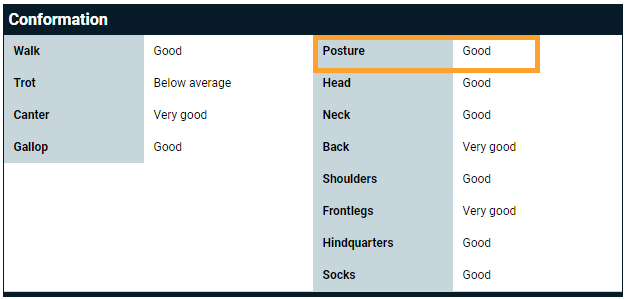
Once again, the number behind the label consists of two alleles. Since we only know its range, rather than the exact number, breeding can be even more unpredictable. Here is a table with just some of the possibilities when you have a “good” posture stat:
| Allele 1 | Allele 2 | Stat |
| 50 (“Below average”) | 95 (“Very good”) | 72.5 (“Good”) |
| 70 (“Good”) | 70 (“Good”) | 70 (“Good”) |
| 84 (“Good”) | 65 (“Average”) | 74.5 (“Good”) |
| 40 (“Below average”) | 100 (“Very good”) | 70 (“Good”) |
¶ Health
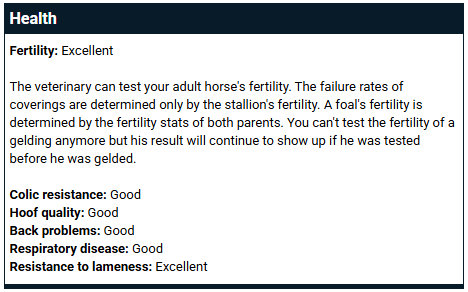
Health stats work similarly to conformation. Rather than a number, the stat is displayed by a label. Read more about the labels and their values on the health page of our wiki.
¶ Height
Height differs from all the other stats in that it only has one allele, not two. A foal inherits the height allele of either its dam or sire, +- RNG. It's not possible to breed a horse with a final height outside its breed boundaries.
¶ RNG (Random Number Generator)
All the numeric alleles are subject to variation by a few points. This means your foal gets one allele of its sire and one of its dam, but both may be varied upwards or downwards by a few points. This was added to the game to simulate the effects the external world has on pregnancies in real life.